14 September 2026
Automated Attention
As with every automation, machines can now produce attentiveness better and more cheaply than humans can. But what are the implications of automating attention?
The PISA 2025 Results report that between 2018 and 2025, reading scores declined by 25 score points on average across 35 OECD countries, which implies, by the OECD’s own rough conversion, that 15-year-old students in 2025 were performing in reading at the level that could be expected of 14-year-olds just seven years earlier. In other words, their development of reading competence was lagging behind by one year, at a minimum. A recent article by The Economist reports that more than 1,800 math and science lecturers at the University of California have signed an open letter reporting that first-year undergraduates increasingly arrive without the basic skills they need to attend university. The article goes on saying that San Diego academics noted that the number of first-year students entering with math skills below high-school level had increased nearly thirtyfold in five years, to almost one in eight, with 70% of the lagging students not performing at the level expected of a 14-year-old. At Harvard some professors say they feel compelled to shorten texts, because students struggle with readings that their predecessors completed with ease just ten years ago.
It seems that attention is in short supply among students, and this is something that would not surprise anyone entering a university classroom nowadays, from London to Cagliari. However, as we automated many human activities that were in short supply throughout history, we recently discovered how to automate attentiveness. Automation is about machines performing activities previously belonging to humans. For instance, I recently restored my self-watering planter, such that I (or any other human being) don’t have to remember to give water to my plants. Nine years ago, Google researchers Ashish Vaswani, Noam Shazeer, Niki Parmar, Jakob Uszkoreit, Llion Jones, Aidan N. Gomez, Łukasz Kaiser, Illia Polosukhin published a paper entitled “Attention Is All You Need”, which introduced the Transformer architecture, completely shifting how modern artificial intelligence processes human language. After less than ten years, AI models are capable of things that were science fiction until a few years ago, but all started with automating attention.
The big breakthrough of the Transformer was changing how AI reads text. Older AI systems read like a person going through a book one word at a time, and by the end of a long paragraph, they’d often forgotten how it started. The Transformer instead takes in the whole text at once. It figures out how every word relates to every other word, no matter how far apart they are. Because nothing must be read in order, the old memory problem disappeared, and models could be trained far faster on modern computer chips. Regardless of the technical details, here is the thing: the machine now could replicate the activity of a trained individual with the ability to read an entire document or better an entire book, because she continuously integrates each new sentence with everything read so far. Ironically (or maybe not), at the same time we invented machines that automate attention, our ability to be attentive is largely declining. Or if you prefer, we automated attention as it started to be in short supply!
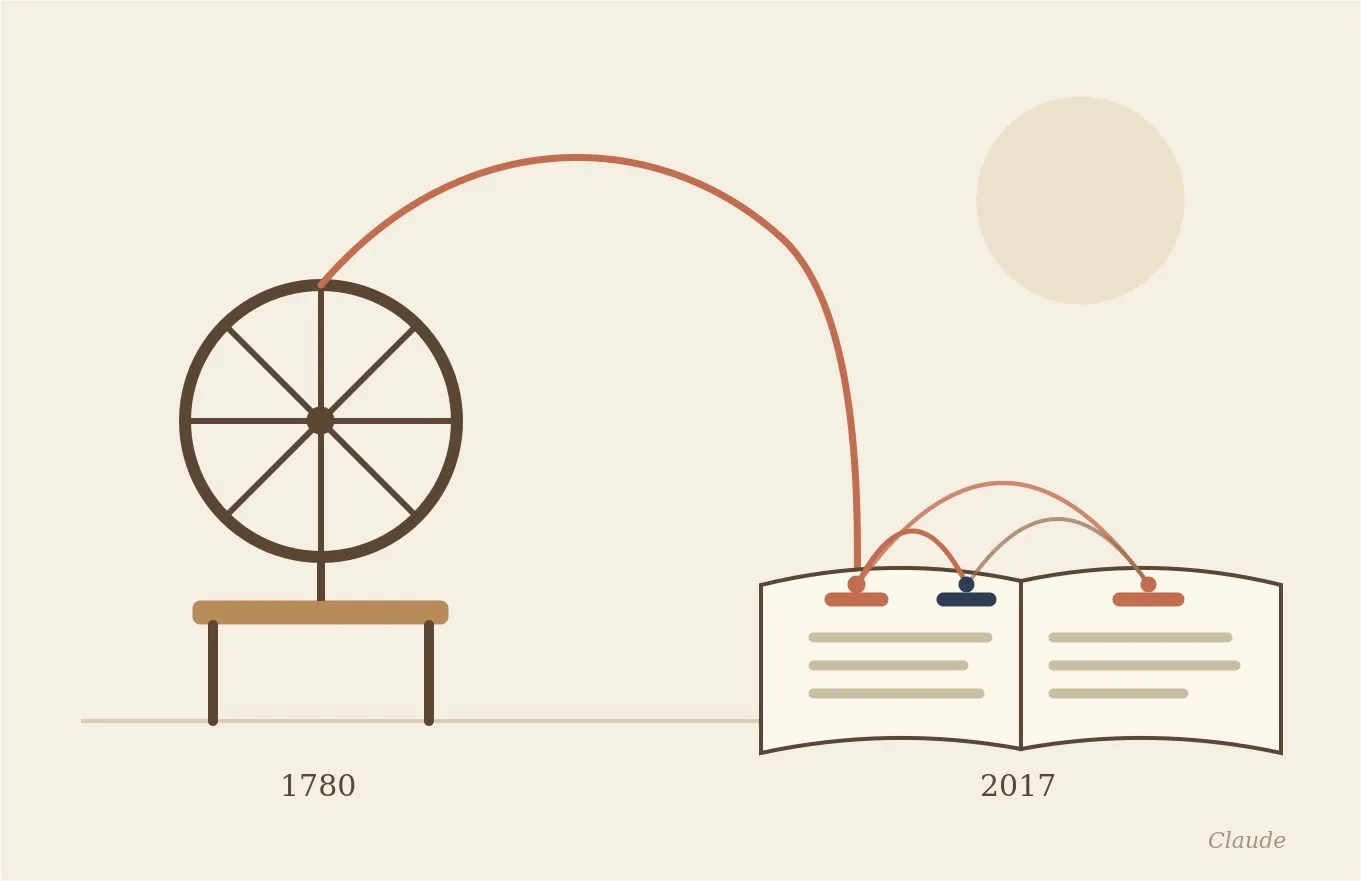
If you think about it, this has happened many times in the history of humanity. When a task or activity is automated, the skill to perform it gradually disappears from the population, because it becomes cheaper to let the machine do it than the human. For millennia, spinning thread by hand was so essential that women in nearly every society did it from childhood. Automated in the 1780s, today virtually no one alive can turn raw wool into usable thread. More recently, reading a paper road map was a universal adult skill in the 1990s, most drivers could follow a route across an unfamiliar country. Satellite navigation automated it within a single decade, and today most adults can no longer orient a map or find their way without turn-by-turn instructions.
Is attentiveness any different from spinning thread or reading a road map? From an economic point of view, there are similarities and a key difference. Regarding the former, all activities are better performed by a machine than by a human, from a certain point in time on, and economically it is cheaper to have the machine do it. The key difference is that attention is a general purpose input that is basically needed for any human activity, thus reducing its availability in the economy might have unexpected consequences for productivity. From a social point of view, though, things might be even more complicated to predict. What does a society look like when attentiveness is in short supply? We can imagine many scenarios, but I hardly see any of them as a pleasant one. (Delegating your AI to evaluate the political options and choosing for you, for instance, does not seem a great idea after all).
I think that educators and policymakers are more than ever put in front of challenges that emerged with the internet and were never faced and are now magnified by the arrival of AI. The main challenge is deciding what fundamental skills we, as a society, want our pupils to still develop. Basic reading? Advanced mathematics? Sustained attentiveness? I don’t have the answer, but what worries me is the lack of debate on this point, especially in western societies. As educators, we are suffering a great deal because students are making AI do their homework. However, the main point is to decide what we want the students to still learn. If it’s writing, then it is the take home essay that is not fit anymore because students now have a mega-cheating device. But in this case, it’s the means to the same end that must be changed, not the end itself. And attention, I believe, is no exception.